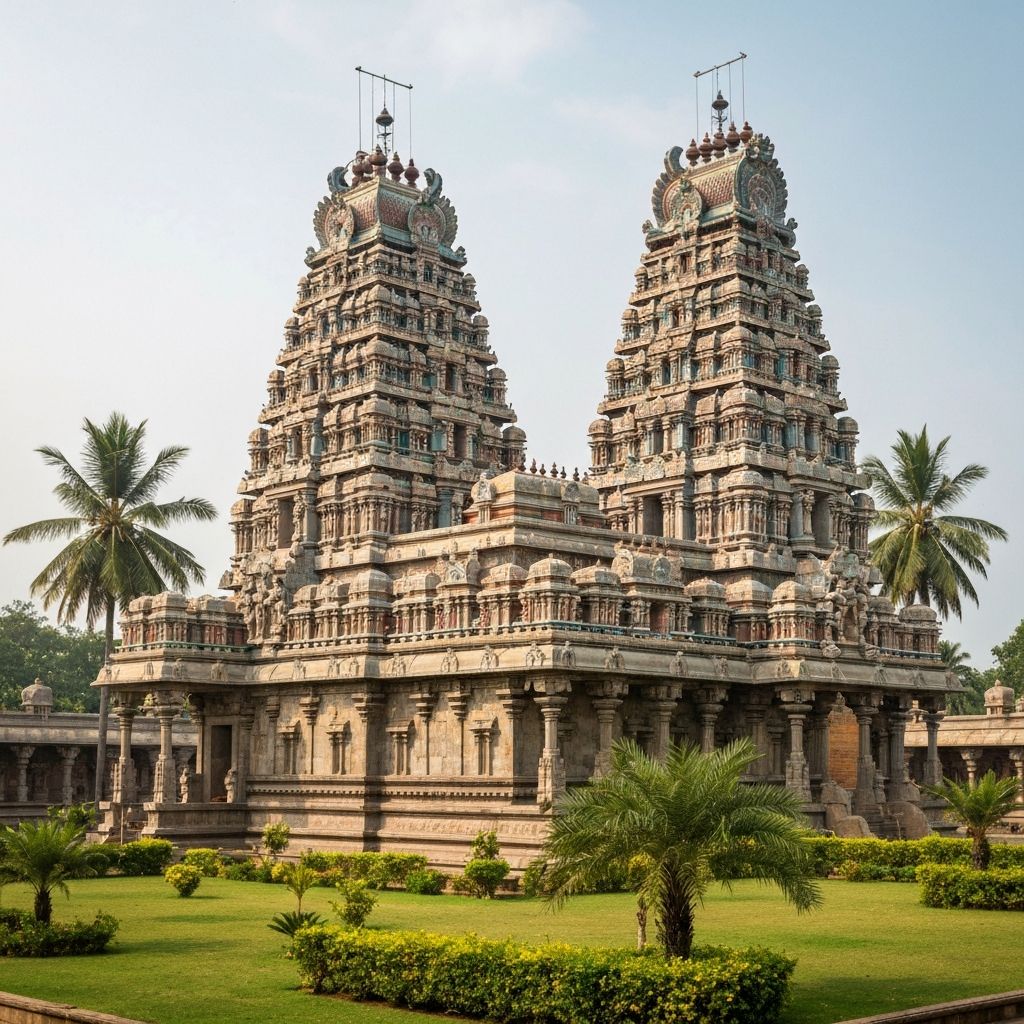
Temple History
A Sacred Legacy Spanning Centuries
Established
Ancient temple with centuries of heritage
Location
Rahata, Ahmednagar District, Maharashtra
Devotees
Thousands of pilgrims visit annually
The Sacred History of Shri Veerbhadra Temple
The Shri Veerbhadra Temple in Rahata stands as a testament to centuries of devotion and spiritual heritage. This ancient temple has been a beacon of faith for devotees across Maharashtra and beyond, drawing pilgrims seeking the blessings of Lord Veerbhadra, the fierce manifestation of Lord Shiva.
Origins and Foundation
The Shri Veerbhadra Temple in Rahata has its origins deeply rooted in ancient Hindu tradition and local legends that have been passed down through countless generations. According to historical records, oral traditions, and archaeological evidence, the temple was established during a period when the worship of Lord Veerbhadra was gaining significant prominence in the Maharashtra region. The exact date of establishment remains a subject of ongoing scholarly research, but evidence from temple inscriptions, architectural styles, and regional historical documents suggests that the temple has been a center of worship and spiritual activity for several centuries, possibly dating back to the medieval period of Indian history.
The foundation of the temple is believed to be connected to the deep spiritual significance of Lord Veerbhadra in Hindu mythology, particularly his role as the fierce protector and destroyer of evil forces. Local legends speak of a divine vision or spiritual experience that led to the establishment of this sacred shrine, where devotees could seek protection, strength, and spiritual guidance. The temple's location in Rahata, Ahmednagar district, was chosen according to ancient Vastu Shastra principles, ensuring optimal spiritual energy flow and alignment with cosmic forces.
Throughout its long history, the temple has been maintained and preserved by successive generations of devotees, priests, and local communities who recognized its profound spiritual importance. The initial construction involved master craftsmen who followed traditional Marathi temple architecture, creating a structure that would serve as both a place of worship and a symbol of divine presence in the region. The temple's foundation stone, laid according to ancient rituals and ceremonies, established it as a permanent abode for Lord Veerbhadra's divine energy.
Architectural Evolution
Over the centuries, the Shri Veerbhadra Temple has undergone several significant renovations, expansions, and architectural enhancements while carefully maintaining its traditional architectural integrity and spiritual essence. The current structure showcases a harmonious blend of ancient Marathi temple architecture with later additions that reflect the devotion, generosity, and architectural innovations of successive generations of trustees, patrons, and devotees. Each renovation period has added layers of cultural and architectural history to the temple, creating a living monument that tells the story of centuries of devotion.
The temple's original architecture followed the classic Nagara style of temple construction, characterized by its distinctive shikhara (spire) that rises majestically towards the heavens, symbolizing the connection between the earthly and divine realms. The garbhagriha (sanctum sanctorum) was designed according to precise mathematical and spiritual calculations, ensuring that the deity's energy would be optimally contained and radiated. The mandapa (hall) was constructed with intricately carved pillars that not only provided structural support but also served as canvases for depicting mythological stories, divine beings, and spiritual symbols.
During various renovation periods, the temple complex was expanded to include additional halls for devotees, administrative offices, accommodation facilities for priests, and spaces for community gatherings and cultural events. The outer walls were adorned with detailed stone carvings depicting scenes from Hindu mythology, particularly stories related to Lord Shiva, Parvati, and Lord Veerbhadra. The temple's entrance was enhanced with a grand gopuram (gateway tower) that welcomes devotees with its intricate carvings and spiritual symbolism.
Modern renovations have focused on structural reinforcement, accessibility improvements, and the integration of contemporary facilities while preserving the temple's ancient aesthetic and spiritual atmosphere. The temple trust has worked with conservation architects and traditional craftsmen to ensure that any additions or modifications maintain the architectural integrity and spiritual significance of the original design. The result is a temple that seamlessly blends centuries-old traditions with modern functionality.
Cultural Significance
The Shri Veerbhadra Temple has played a crucial and multifaceted role in preserving, promoting, and enriching Hindu religious traditions in the Rahata region and beyond. Throughout its long history, the temple has served as far more than just a place of worship—it has been a vibrant center for religious education, cultural activities, community gatherings, and spiritual transformation. The temple's influence extends beyond its physical boundaries, touching the lives of countless devotees and shaping the cultural and spiritual landscape of the region.
The annual festivals celebrated at the temple, particularly Mahashivratri (the Great Night of Shiva), have become integral to the cultural fabric of the local community and attract pilgrims from across Maharashtra, India, and even from abroad. These festivals are not merely religious observances but grand cultural celebrations that bring together people from diverse backgrounds in a shared experience of devotion, community, and spiritual renewal. The temple's celebration of Shravan month (dedicated to Lord Shiva) creates a month-long period of intense spiritual activity, with special poojas, extended darshan hours, and community participation that reinforces the temple's role as a cultural anchor for the region.
The temple has also been a center for preserving and transmitting traditional knowledge, including Vedic studies, Sanskrit learning, ritual practices, and spiritual teachings. Priests associated with the temple have maintained ancient traditions of worship, passing down knowledge from generation to generation. The temple's library and educational programs have contributed to the preservation of religious texts, mantras, stotras, and traditional practices that might otherwise have been lost over time. The temple's role in cultural preservation extends to music, with regular bhajan and kirtan sessions that keep alive traditional devotional music forms.
Beyond religious and cultural functions, the temple has served as a social institution, bringing together community members for various social, charitable, and educational activities. The temple trust has organized numerous community service initiatives, educational programs, and charitable activities that have strengthened social bonds and contributed to community development. The temple has become a symbol of unity, bringing together people from different walks of life in shared devotion and service.
Modern Era
In recent decades, the Shri Veerbhadra Temple has successfully embraced modernization and technological advancements while remaining steadfastly true to its spiritual roots and ancient traditions. The establishment of the temple trust has been a crucial development that has ensured proper management, financial transparency, systematic development of facilities, and long-term sustainability of the temple's operations. The trust has implemented modern administrative systems, financial management practices, and governance structures that ensure the temple's continued growth and service to devotees.
Today, the temple continues to serve as a vital spiritual center, welcoming thousands of devotees who come from near and far to seek the blessings of Lord Veerbhadra. The temple has adapted to contemporary needs by introducing online pooja booking systems, digital donation facilities, live streaming of major ceremonies, and comprehensive websites that provide information about timings, festivals, and spiritual resources. These technological innovations have made the temple more accessible to devotees while maintaining the sanctity and traditional nature of the worship experience.
The temple's modern facilities include well-maintained parking areas, clean restroom facilities, drinking water stations, and accommodations for out-of-town devotees. The temple has also established a comprehensive system for managing daily worship, special poojas, festivals, and community events. The trust has invested in infrastructure improvements, security systems, and maintenance programs that ensure the temple remains a safe, welcoming, and spiritually uplifting environment for all devotees.
Looking towards the future, the temple continues to evolve while maintaining its core mission of serving devotees and preserving spiritual traditions. The temple trust is actively involved in planning for future expansions, facility improvements, and program enhancements that will ensure the temple remains relevant and accessible to future generations. The temple's commitment to both tradition and innovation positions it as a model for how ancient spiritual institutions can thrive in the modern world while preserving their essential spiritual character and cultural heritage.
Preservation Efforts
The temple trust is committed to preserving the historical and architectural heritage of the temple while ensuring it remains accessible and relevant to contemporary devotees. Ongoing conservation efforts aim to protect the temple's ancient structures and artifacts for future generations.